System Thinking
TOCnomics
Theory of Constraints + Economics

What is the goal of a company?
I believe most of us would agree that the goal of a for-profit company is to make money now and in the future.
The next question to ask is ‘When does a company make money?’
Profit = Revenues − Expenses (Variable + Fixed)
Whenever, for a period, revenues earned by the company are more than all the expenses, the company makes a profit.
There is no doubt that stability and growth are just two faces of the same coin. Thus, it is prudent to assume that companies are looking to grow year on year.
Now, the question in front of the company is:
What should be done to achieve the feat of year on year growth?
This article explores the approach taken by the TOC (Theory of Constraints) management philosophy to address this seemingly simple question (which I coined as TOCnomics). And for the sake of keeping things simple, interesting and relevant, I will take an example to illustrate this approach.
Let us assume organization ABC is in the business of manufacturing candies and has the following Profit and Loss account for the financial year 2017–2018.
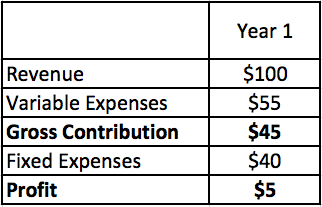
Profit for the company is $5.
If one needs to increase the profit for this company, or let’s take a more daunting task of doubling the profit, then what is to be done?
By referring to the equation for profit above, the management of ABC can explore the idea of increasing profits in the following ways (three variables >> three possible ways):
- Decrease fixed expense
- Decrease variable expense
- Increase revenues
Note: More than one of the above approaches can be taken simultaneously to increase the profit, but for conceptual clarity (& simplicity) let us take only one approach at a time.
Decrease fixed expense
Typically fixed costs for a company are rent, machinery (depreciation), salaries, interest cost, insurance etc.
If one is looking to lower fixed expense, then one needs to trim down — plant, machines, or people. Plants and machines are not easy to dismantle. Also, it’s not advisable to shut down the plant, unless a company is no longer in a position to sustain its cost (shouldn’t be the case for a growing company).
Further, people (including top management) expect their salaries to go up year on year and not the other way round.
If we plot the curve of fixed cost for a growing company, which trend do you expect to observe — A, B or C?
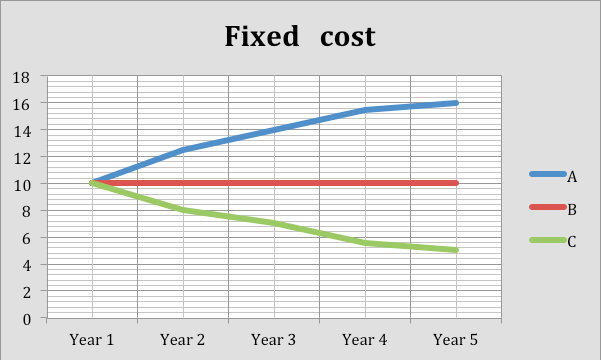
Most likely, growing organizations would experience trend ‘A’: fixed costs going up steadily year on year, as salaries, rent etc. go up as per inflation.
It is observed that even when organizations take up serious cost-cutting initiatives, the impact is mostly limited to 4–5%.
Let’s go back to the P&L of ABC. For doubling the profit, one needs to reduce fixed expenses by $5, which is around 12.5%. Even though it’s a big number, for a moment let us assume that ABC was able to do it for one year. Do you think that this ‘trimming the fat’ could be repeated year on year to achieve growth (even assuming a 5% cut)?
Would a company which is reducing people, plant or machines to grow even exist in the long run? Absolutely not.
This can’t be done year on year. Period.
Decrease variable expenses
Typical variable expenses associated with manufacturing candies are raw material, packaging, transportation, and sales commissions.
If one is looking to lower variable expense, then one needs to visit vendors to renegotiate the purchase price, or find a new vendor at a lower price, or negotiate a better deal with a transporter.
No doubt one can achieve some improvements in this area. The extent might not be significant, considering that product quality needs to be maintained to meet customer satisfaction. However, the real question here is whether this approach can be considered for increasing profits year on year, i.e. will vendors/transporters agree to cost reduction year on year, or will they be asking for a cost increase on account of inflation in the economy?
What do you think is going to be the most likely scenario?
Further, many of us have experienced that whenever such a cost-cutting decision is taken in one department of the organization, it has a negative impact on another part of the organisation.
E.g. the decision taken to reduce transportation cost leads to the logistics department bringing a policy of ‘batching customer orders to ensure full truck formation’ (action taken to reduce cost). This might cause delays in fulfilling customer orders in time. And if delayed delivery becomes the norm, which is expected to happen due to the new policy, then the company either pays a penalty or loses the customer.
I don’t have to emphasize the repercussion/cost of losing a customer.
This happens because the departments in the organization are interdependent and action taken in one area impacts the other. Hence, action taken to ensure a local optimum might not translate into the global optimum.
Continuing the example of doubling the profit, one needs to bring down the variable expense to $50 from $55, i.e. ~9% reduction. Do you think such a reduction is possible? Let us assume it’s possible; what do you think the impact is going to be on product quality, vendor support, transporter delivery commitments etc.?
And going back to the question: can it be done consistently year on year?
I think you have got the point.
Increasing revenues
When two of the three options considered above can’t be taken as a strategy to grow the company year on year, it’s natural to assume that increasing sales is the only option left for companies to grow year on year.
Am I implying increasing sales without considering the impact on cost? No.
The increase in gross contribution (GC) for a company (revenues − variable expense) should be more than the increase in operating expenses (OE). And this increase in GC is to be achieved by increasing sales, as the variable expense would go up in proportion and operating expenses would also go up on account of inflation/salary increases.
Now, if the company has to increase profit significantly (double) in a year, then how much growth in sales should it have?
Is it 50%, 75% or 100%?
What is your estimate of the percentage growth required in sales for doubling the profit?
Pause here and think about it for a minute before moving forward.
Let’s continue our example, for profit to go up to $10 while considering a fixed cost increase of 10% (YoY). The following is the calculation.
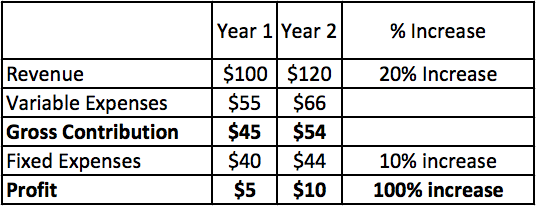
So, a mere 20% increase in sales — not 50%, 75% or 100% — is sufficient to deliver an impressive 100% jump in profit for organization ABC.
Now, going back to the question:
Can it be done consistently year on year to achieve growth?
An increase in sales can be achieved year on year, and from the above example it’s clear that even to double the profit, the quantum of sales jump is not out of reach.
And I would agree that it’s difficult to double the profit year on year, but the company can consistently increase its gross contribution (GC) (revenues − variable expense) more than the increase in operating expenses by focusing on sales and not on decreasing costs — and achieve the twin objective of growth and stability.
TOCnomics is — the company ‘focusing’ on sales growth and ‘not on’ cost control, and thereby ensuring that the company’s rate of growth in GC is higher than the rate of OE increase.

Strategy, supply chain & sales transformation consultant. About · Book a discussion